I Asked a Hall of Students What They Do With AI. Every One Said Homework.
Last Sunday I stood in front of a hall of students at an academy and asked what I thought was an easy question. The answer stopped me, and it is the reason this school exists.
The question
I asked them: what do you actually do with AI?
Not what have you heard about it. Not what do you think about it. What do you do with it, on a normal day, with your own hands.
Hands went up. And the answer came back almost unanimous.
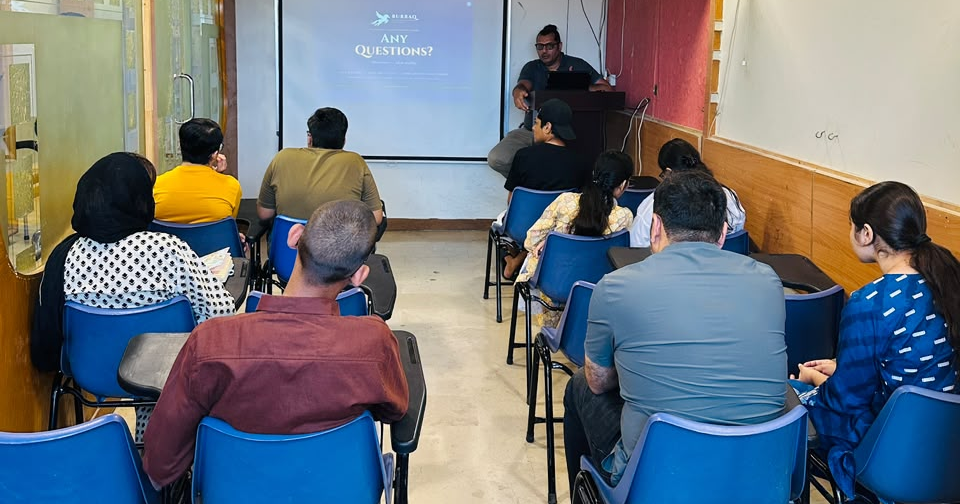
They paste a question into ChatGPT. They copy the answer back out. They hand it in.
That was it. That was the whole relationship these young people had with the most significant technology of their lifetimes.
So I kept asking
Has anyone built an automation? Something that runs on its own, without you?
Nothing.
Has anyone here used Claude?
Nothing. Not one hand. Several of them had not heard the name.
Can anyone tell me what an AI agent is?
Silence — the particular silence of a room where nobody is embarrassed, because nobody knew there was anything to know.
And that is the part that has stayed with me all week. They were not lazy. They were not uninterested. They were bright, curious students who had simply never been shown that a door existed.
Consumers and builders
There is a line running through the world right now, and almost nobody has noticed it.
On one side are the people who consume AI. They ask a chatbot questions and read the answers. This is genuinely useful, and it is where more than ninety-nine percent of people stop.
On the other side are the people who build with it. They give AI tools. They give it access to their files, their email, their spreadsheets. They set it running on a schedule. They wake up to work that finished while they were asleep.
The gap between those two groups is not intelligence. It is not age, and it is certainly not a computer science degree.
It is about ninety days of being shown the right things in the right order.
The best explanation I know
Here is the difference in one sentence.
Regular AI is a genius telling you how to make a sandwich. An AI agent goes and makes the sandwich.
Every student in that hall had the genius. Not one of them had the sandwich.
And once you see it that way, you cannot unsee it. A chatbot that tells you how to sort five hundred files is mildly interesting. A tool that sorts the five hundred files is a different category of thing entirely.
Why “just use ChatGPT” is not enough
I want to be fair here. Using a chatbot for schoolwork is not a crime, and the students who told me that were being honest.
But consider what that habit actually teaches:
- Ask a question, accept the answer
- Never check whether the answer is right
- Never build anything that outlives the conversation
- Never learn what the machine is actually capable of
That is a habit of dependence. The skill that matters — the one that will still be worth money in ten years — is the opposite: directing a tool, judging what it gives back, catching its mistakes, and shipping something real.
That is harder than copying an answer. It is also the entire job.
What I think we are getting wrong
Most of the conversation about young people and AI is about stopping them. Detect the cheating. Ban the tools. Catch them out.
I understand the instinct. I think it is aimed at the wrong target.
The problem in that hall was not that students were using AI too much. It was that they were using one percent of it, badly, and nobody had ever shown them the other ninety-nine.
You do not fix that with a ban. You fix it by teaching.
What I am doing about it
I have spent the last years building automations that run real businesses — systems that publish, message, track and report without me touching them. I did not learn that at university. I learned it by building, breaking and rebuilding, every day.
So I am teaching it, starting with the foundation: Claude Code. It is the tool I use most, it is the one that turns instructions in plain English into work that actually happens on your computer, and nobody in that hall had heard of it.
Six live sessions. From “what is a model” to your own automation running on a schedule. No coding background needed — that is the point of the tool.
There is no age limit. Students are welcome. So are their parents, and so is any business owner who is tired of doing the same task forty times a month.
The thing I keep thinking about
Somewhere in that hall was a student who, if shown the door, would walk through it and not stop. Who would build something in a month that would surprise all of us.
Right now, that student is using a tool worth billions of dollars to finish their chemistry homework. Not because they lack ambition — but because nobody told them the door was there.
That is what I am trying to change. One hall, one cohort, one student at a time.
Claude Code Basics — first cohort starts 1 November 2026
Six live online sessions. 12 seats only. No age limit, no coding background needed.